Mortality, Health and Ageing
The seminar is offered in the winter semester—together with Sonja Spitzer—as part of the MA programme “Global Demography” at the University of Vienna. I will contribute four sessions on the topic of “Life Expectancy.”
Course Description
Aims:
This course provides an introduction to the interdependent topics of mortality, health, and ageing, thereby focusing on different trends and patterns across time, space, and population subgroups. Students will learn about the micro-level drivers and macro-level consequences of the mortality transition and their link to global health and population ageing, considering the interaction of demographic, social, and economic processes. We will also discuss and apply various measures for health and ageing and explore relevant data sources. Finally, students will critically reflect on strategies to overcome challenges in public health and demographic ageing in both low- and high-income countries.
Seminar units on life expectancy:
This course provides an introduction to the interdependent topics of mortality, health, and ageing, thereby focusing on different trends and patterns across time, space, and population subgroups. Students will learn about the micro-level drivers and macro-level consequences of the mortality transition and their link to global health and population ageing, considering the interaction of demographic, social, and economic processes. We will also discuss and apply various measures for health and ageing and explore relevant data sources. Finally, students will critically reflect on strategies to overcome challenges in public health and demographic ageing in both low- and high-income countries.
Seminar units on life expectancy:
- Gender differences in life expectancy: biological versus non-biological factors
- Determinants of health and longevity: from macro to(wards) micro level
- Gender paradox in health and longevity: extending life expectancy to health expectancy
- Indirect estimation of life expectancy/Estimation of healthy life years/Tempo effects
Minimum Requirements and Assessment Criteria
The performance components consist off:
The final grade will be determined as follows
- Written research report (40%): Students will write a report on a course-related topic
- Presentation (40%): Students will present a course-related topic during class.
- Preparation and active participation (20%): Students are expected to work on short assignments and readings before, during, and after class. Moreover, they are asked to actively participate in class, especially during interactive sessions, exercises, and in-class discussions.
The final grade will be determined as follows
- 100%-91%: Excellent (1)
- 90%-81%: Good (2)
- 80%-71%: Satisfactory (3)
- 70%-60%: Sufficient (4)
- < 60%: Unsatisfactory (5)
Age decomposition of gender differences in life expectancy at birth in three countries
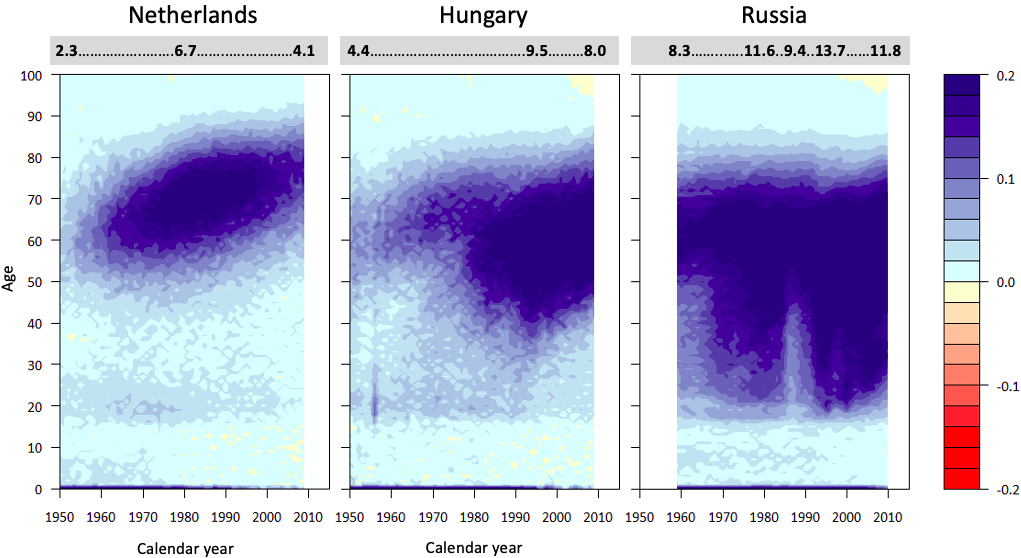
Source: own calculations with data from the Human Mortality Database.