Introduction to Demographic Theories, Global Human Capital and Social Change
The lecture is offered in the winter semester as part of the Master's Programme “Global Demography” at the University of Vienna.
Course Description
Aims:
This lecture provides an introduction to the principles and foundations of demography as a scientific discipline. It presents the historical development of demographic thinking as well as the core concepts and approaches that distinguish demography from other social sciences. A particular focus is the Vienna School of Demography (VSD), a new approach to understanding demographic change from a multi-dimensional perspective. At its core are three scientific innovations that have been developed over several decades in the Vienna area: the concept of demographic metabolism, the incorporation of educational attainment as a key dimension of population structure alongside age and sex, and multi-state modeling as the methodological foundation for their empirical implementation. Together, these innovations constitute the foundations of an integrated Theory of Demographic Change, linking demographic processes to the accumulation of human capital and its broader social, economic, and environmental consequences. Upon successful completion of the course, students will be familiar with the VSD approach and equipped with a sound foundation in demographic thinking and its application to many of the pressing challenges of our time.
Contents:
The lecture begins with a brief overview of the history of demography and introduces the basic concepts and methods of the discipline, including occurrence/exposure rates as the basis of demographic indicators, the life table, the stable population model, and the frameworks of cohort and period analysis. It then traces the development of the Vienna School of Demography (VSD) from its origins to the formulation of its integrated Theory of Demographic Change, showing how this framework offers new perspectives on major demographic patterns and their broader social and economic consequences. Particular attention is given to the reinterpretation of the demographic dividend as an education-triggered demographic dividend, driven by changes in the educational composition of the population, and to the demographic transition as a cognition-driven demographic transition, emphasizing the role of human capital and cognitive change. The lecture also addresses selected related topics and presents the Wittgenstein Centre Global Population and Human Capital Projections as the principal empirical implementation of the VSD through alternative population scenarios by age, sex, and educational attainment.
Method(s):
The course is primarily lecture-based, complemented by question-and-answer sessions and discussions.
Readings:
The material will be based largely on the books "Advanced Introduction to Demography" by Wolfgang Lutz and "The Vienna School of Demography: Multi-Dimensional Demography of Human Capital," edited by Marc Luy and Wolfgang Lutz. Additional readings relevant to individual topics and examination will be assigned during the course.
Click here for the current schedule and room information for the lecture
This lecture provides an introduction to the principles and foundations of demography as a scientific discipline. It presents the historical development of demographic thinking as well as the core concepts and approaches that distinguish demography from other social sciences. A particular focus is the Vienna School of Demography (VSD), a new approach to understanding demographic change from a multi-dimensional perspective. At its core are three scientific innovations that have been developed over several decades in the Vienna area: the concept of demographic metabolism, the incorporation of educational attainment as a key dimension of population structure alongside age and sex, and multi-state modeling as the methodological foundation for their empirical implementation. Together, these innovations constitute the foundations of an integrated Theory of Demographic Change, linking demographic processes to the accumulation of human capital and its broader social, economic, and environmental consequences. Upon successful completion of the course, students will be familiar with the VSD approach and equipped with a sound foundation in demographic thinking and its application to many of the pressing challenges of our time.
Contents:
The lecture begins with a brief overview of the history of demography and introduces the basic concepts and methods of the discipline, including occurrence/exposure rates as the basis of demographic indicators, the life table, the stable population model, and the frameworks of cohort and period analysis. It then traces the development of the Vienna School of Demography (VSD) from its origins to the formulation of its integrated Theory of Demographic Change, showing how this framework offers new perspectives on major demographic patterns and their broader social and economic consequences. Particular attention is given to the reinterpretation of the demographic dividend as an education-triggered demographic dividend, driven by changes in the educational composition of the population, and to the demographic transition as a cognition-driven demographic transition, emphasizing the role of human capital and cognitive change. The lecture also addresses selected related topics and presents the Wittgenstein Centre Global Population and Human Capital Projections as the principal empirical implementation of the VSD through alternative population scenarios by age, sex, and educational attainment.
Method(s):
The course is primarily lecture-based, complemented by question-and-answer sessions and discussions.
Readings:
The material will be based largely on the books "Advanced Introduction to Demography" by Wolfgang Lutz and "The Vienna School of Demography: Multi-Dimensional Demography of Human Capital," edited by Marc Luy and Wolfgang Lutz. Additional readings relevant to individual topics and examination will be assigned during the course.
Click here for the current schedule and room information for the lecture
Minimum Requirements and Assessment Criteria
At the end of the course, there will be one comprehensive in-room exam. No aids are permitted.
- Maximum number of points (percent) that can be achieved: 100.
- Minimum requirement for a positive result: 50 points (percent).
- 100-89%: 1 (Excellent/Sehr gut)
- 88-76%: 2 (Good/Gut)
- 75-63%: 3 (Satisfactory/Befriedigend)
- 62-50%: 4 (Pass/Genügend)
- < 50%: 5 (Fail/Nicht genügend)
- Principles and foundations of demography
- Basic demographic concepts and methods
- Stable population model
- Life table model
- Core elements of the Vienna School of Demography
- Theory of demographic change
- Model/theory of demographic transition
- Model/theory of a demographic dividend
- Drivers of mortality decline
- Drivers of fertility decline
- Wittgenstein Centre Global Population and Human Capital Projections
- Related topics (to the extent covered in the lecture)
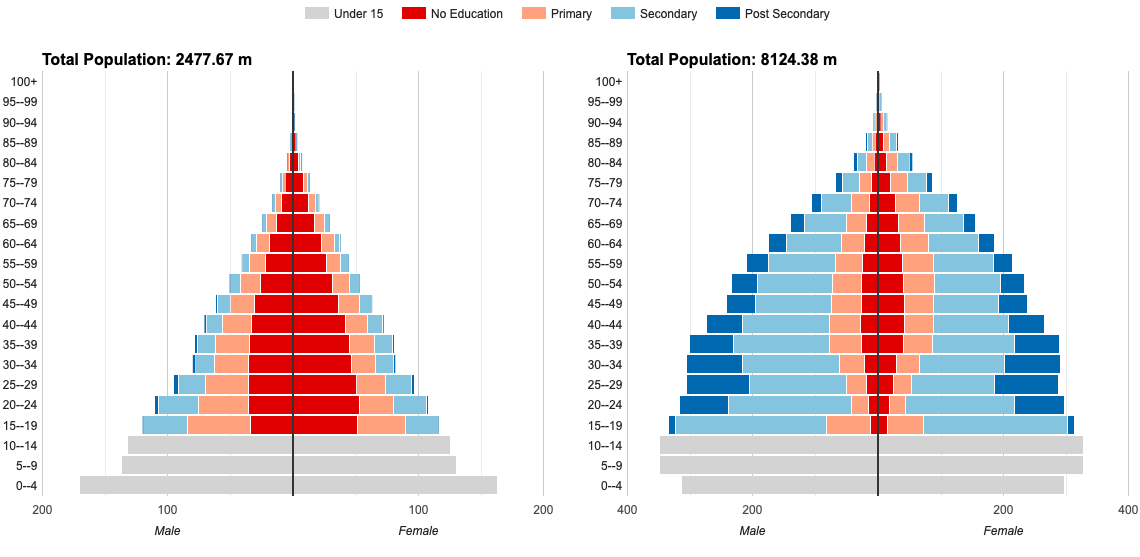
World population by age, sex and education in 1950 (left graph) and 2025 (right graph)